
Why do more women donate organs than men?
Features correspondent
 Getty Images
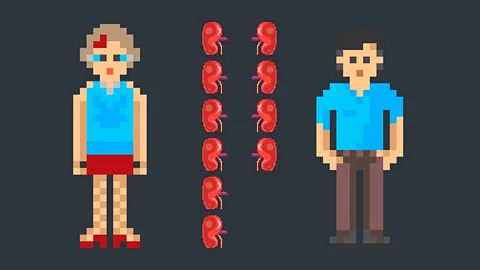
Six in 10 kidney donors are women – but some 6 in 10 recipients are men. This may have health consequences for both genders.
By 2016, my mother’s kidneys had started to fail – again. Her first transplant had come from a cadaver she matched with after several years on the waitlist. But this time around, her youngest sister was ready. She chose to be my mother’s donor.

 BBC/Getty
The fact that more men need kidneys, but more women give them, doesn’t just mean an extra burden on women. It could have potential health consequences for men too.
 BBC/Getty
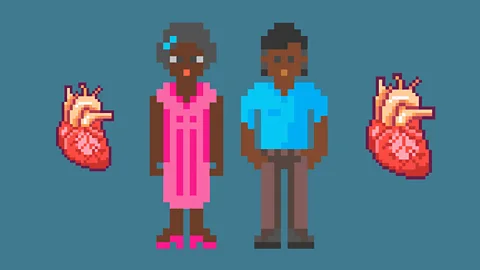
Even if a woman and man weigh the same, though, a woman’s organs still tend to be smaller. But often the only size-related aspect taken into account is body weight – which could contribute to some of the gender mismatch risk. The same graft failure analysis found that a female donor-male recipient pairing had the same risk as when the recipient weighed 10-30kg more than the donor. For heart donations, meanwhile, researchers found that using a more precise model than body weight to predict cardiac mass made the risk of female-to-male donations disappear.
Aside from size, another issue is that men and women’s bodies have different antigens. But new medical advancements have meant that that is becoming less of a problem, says Barth. “In the modern era, we use more intense induction immunotherapies,” he says. “These differences about matching and gender have been minimised.”
 BBC/Getty
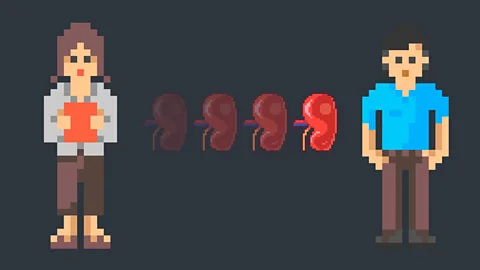
It isn’t clear what causes those disparities. But there are some solid theories about why so many more women than men donate.
 BBC/Getty
But that doesn’t account for all of it. Women also far outstripped men in donating to their children, a sibling or another family member, for example.
Another reason may be economic. Donors need to take several weeks off of work for the surgery and recovery process, and the US healthcare system has nothing in place to make that sacrifice financially neutral. My aunt, who had to forego income during her four-week recovery period, estimates that she lost a total of $8,000 to $10,000. Even in countries like Switzerland, where loss of income is reimbursed, administrative hurdles mean that getting payments can take weeks. Men, who remain more likely to be the sole breadwinner in their household, may be less likely to give as a result.
But not everyone agrees that the disparity is because families are less reliant on women for income.
“Women, regardless of their work status, are the caregivers for their family, and they see what their family member goes through with dialysis,” says Cathy Klein-Glover of the University of Maryland Medical Center. “And just because of that role, they’re more likely to say, ‘I’m going to step up and be the resolution to the problem’.”
 BBC/Getty
As the transplant clinical team lead, it is Klein-Glover’s job to evaluate potential donors and determine whether they’re good candidates for organ donation, with the right social support in place to ensure a successful recovery.
In her experience, she says, “women are more likely to see themselves as the solution” to the problem than men.
In general, women are more socialised to see caring for their family members as an extension of their domestic duties. This, experts say, may be the main driving force of the disparity.
“There is a general social expectation that women will be givers,” says Bethany Foster, a physician who focuses on kidney research at McGill University in Canada.
This lines up with what medical anthropologists discovered when they conducted a study of attitudes towards living organ donation in Egypt and Mexico. Both cultures placed especially high expectations on mothers to donate their organs to their children, and conflated motherhood with a willingness to donate.
“Drawing a resonant analogy between giving birth and giving a kidney, mothers’ bodies were explicitly envisioned as the source of life from which both fully formed babies and organs could be extracted,” the study says. “Taking one more organ from that same source was rendered an organic continuation of that bodily intimacy and interdependence.”
 BBC/Getty
In fact, many of the female donors Klein-Glover has interviewed are willing to donate because they’ve already experienced a major medical event like childbirth. As a result, she says, “they trust the medical system. Sometimes they’ll say to me, ‘Compared to what I’ve been through, this doesn’t seem bad at all.’”
But there is an underlying irony: having been pregnant is yet another of the biggest complicating factors of organ donation for women who want to donate or need a transplant.
In the future, experts say, they hope that more research and attention from the medical community can dispel some of the cultural and financial barriers in place when it comes to organ donations.
“Hopefully this will make people think of themselves as donors,” says Klein-Glover – regardless of cultural expectations.
This story is part of the Health Gap, a special series about how men and women experience the medical system – and their own health – in starkly different ways.
Do you have an experience to share? Or are you just interested in sharing information about women’s health and wellbeing? Join our Facebook group Future Woman and be a part of the conversation about the day-to-day issues that affect women’s lives.
Source link